Tuesday
09Mar2010

Farm Snapshots


The Spring is our favorite time of year around the farm.

Things begin to come alive. Grasses become greener. Wildflowers sprout forth. You can feel the warmth of the sun pressed up against your face.

Today felt like our first real glimpse of Spring. It was almost poetic around here. The animals seemed a little giddy.

But, then again, so did I.

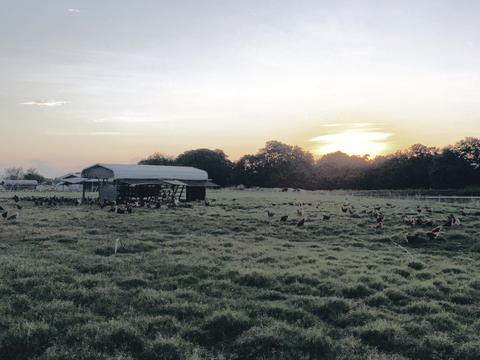
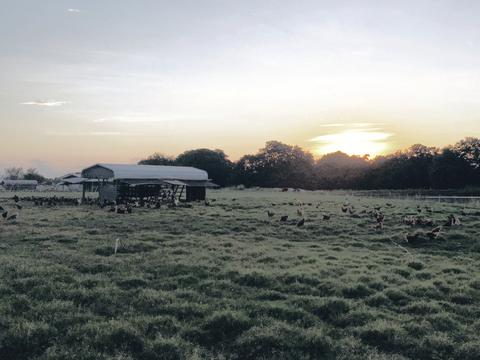
I snapped this photo of the chickens meandering through the pastures. You can see the cows in the background (way back there) up on top of the hill.

We follow our cows with our chickens. The chickens go behind the cows and help clean up the pastures and break up the manure.

They also help when the flies get back as it gets warmer because they eat the fly larvae out of the cow manure.

In other news, we recently purchased a small herd of Spanish Goats.

The purpose of these goats will be for natural pasture renovation and parasite control.

Goats won't compete with the cows for grasses since goats are browsers and cows are grazers. The goats eat things that cows won't eat.

It is quite a sight looking out into the pasture seeing the goats romping around. 


The goats won't let us get too close to them yet. We aren't use to our animals keeping their distance from us. But, in due time I'm sure the goats will come around as well.

The girls can't hardly stand this though. They've made many trips out to the pasture that the goats are in with many coaxing efforts to end in,"They just aren't ready yet."

They have taken a liking to the dogs though. The ranch that they came from worked them with dogs. We can't wait to see what kind of goat wrangler Max will end up being.

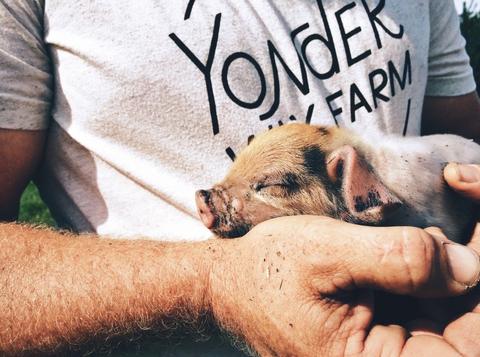
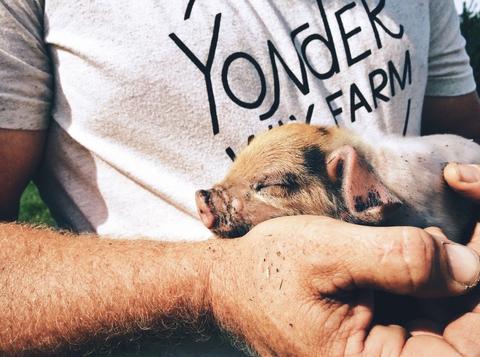
We had a momma sow farrow the sweetest litter of piglets to date. She had some very uniquely colored piglets. Some where speckled and one of them was brown. We don't have one single brown pig on this farm, but little one.

The sow is doing quite well at being a first time momma. She is young and this is her first litter of piglets. But, we've been impressed with her so far. She had a total of 10 and hasn't lost any yet.

Losing piglets tends to be just part of the game sometimes. We've had tremendous success with huge litters of pigs. The average loss is usually 1 to 2 piglets per litter- sometimes none, sometimes more. Most of the time, they are stepped on by the sows or crushed by them when they lay down to nurse.

Today, we were outside playing in the yard. I heard the loudest piglet squeal coming from the barn. Instantly, I rushed over to the barn (common protocol) because I knew the owner of the squeal was in a very precarious position.

When I arrived, I saw the little piglet half under the sow and pinned up against the fence. I made the sow stand up and quit nursing the piglets. I'm just glad that she kindly obliged and didn't give me any resistance.

The little guy was up and running in no time.

And I felt like I had bonded with the piglet over saving his week old life.


Thursday
25Feb2010

Farmer's Favorite Potato & Ham Soup

This hearty potato soup has been a favorite on the farm this winter. I love it because it requires very few ingredients, but the flavors are incredible and satisfying.

This particular potato soup is definitely not low-cal, but we aren't affraid of butter around here- especially grass-fed golden butter. Yum Yum!

"Nourishing" is the best way to describe this soup and it's most definitely a crowd pleaser.

Who knew soup could be this simple?

Potato & Ham Soup

8 potatoes- peeled and cut into chunks

1 to 2 lbs of Yonder Way Farm's Ham Steak- thawed and cubed

1 whole Onion- chopped

4 tbsp of Stryk's Dairy grass-fed raw butter

water (refer to recipe for how much)

1 cup raw milk from Stryk's

1/4 cup of raw milk sour cream from Stryk's

1 tbsp dried chives

Sea Salt & Pepper

Place your cubed ham steak in a pot to brown with butter and onions on medium heat. Once the meat is browned, add potatoes, chives, salt, pepper, and enough water in the pot to cover the potatoes. Simmer on medium high heat and bring to a nice rolling boil. Boil potatoes until tender. Add raw milk and sour cream and simmer for about 5 more minutes until all of the flavors marry together. Enjoy!


Friday
19Feb2010

Puppy Love

Many of you know that our beloved Rowdy, farm dog extraordinaire, was hit by a car in November.

We've been wanting another farm dog, but were waiting for the right one to come along.

A man literally drove up our driveway and gave us our newest addition to the farm. Therefore, we assumed that this was indeed the "right one".

Meet Max. Isn't he a cute little fella?

He is a 7 wk old Australian Shepherd. He has to be one of the smartest, calmest, and cutest puppies I've witnessed to date.

The girls are smitten over him. I have to admit. I am too.

Farmer Jason has already taken him on errands with him and has high hopes that he will be a good working farm dog.

Max is quite fond of farm life and has received a total of 3 baths since he's been here- for a week.

On one occasion, he was sprayed by a tom cat. Can we say GROSS???

On another occasion, he discovered mud.

On the last occasion, he decided to eat pig poop.

I feel like I have a newborn living in this house all over again. Puppies are hard work. But, oh so fun!

Monday
15Feb2010

eggs in a tree


You've probably heard the saying,

"Don't count your chickens before they hatch."

Well, I have a new one for you.

"Don't lay your eggs in a tree."

Bad things can most definitely happen.

I looked out of the schoolroom window this morning and saw a chicken in our oak tree (see above photo). This sight alone sort of shocked me.

But, as I took a closer look, I noticed she was sitting on eggs and was clearly troubled because some had just fallen out of the tree and on to the ground

Duh???

Poor gal.


And I'd like to draw your attention to those yolks. Yes, those beautifully vibrant orange yolks.

I did not alter the coloring in any way in this photo. They are naturally that orange.

When you raise chickens on pasture, their yolks take on an orangish color. This is how you know if they've in fact been raised on grass.

I use to think that egg yolks were yellow. But, in fact, they are orange- or at least should be.

Who knew?

Here are some facts about the eggs that hens lay that are raised on pasture (from Mother Earth News):
  • 1/3 less cholesterol
  • 1/4 less saturated fat
  • 2/3 more vitamin A
  • 2 TIMES more Omega-3 fatty acids
  • 3 TIMES more Vitamin E
  • 7 TIMES more beta carotene
With all of the food labeling that is being done these days, things can get a little confusing.

Did you know that the government owns the term "free-range" now?

They bought this term so that farmers now have to pay big bucks in order to label their eggs using this terminology.

That is why we have to say that our eggs are "pastured".

Not to be confused with "pasteurized".

You'd be AMAZED at how many people call our farm asking to buy,"Some of them there PASTEURIZED eggs." I digress. Geez.

Still trying to figure that one out. Not sure how one could pasteurize and egg if they so desired. I suppose then, that would be a hard boiled egg that would need a good shellin'.

Okay, sorry, back on task here.

But, what is even more troubling is the way that the government has defined what "free-range" even means.

From Mother Earth News in "Meet Real Free-Range Eggs":

""A statement on the American Egg Board’s Web site says “True free-range eggs are those produced by hens raised outdoors or that have daily access to the outdoors.”

Baloney. They’re trying to duck the issue by incorrectly defining “true free-range.” And the USDA isn’t helping consumers learn the truth, either: “Allowed access to the outside” is how the USDA defines “free-range.” This inadequate definition means that producers can, and do, label their eggs as “free-range” even if all they do is leave little doors open on their giant sheds, regardless of whether the birds ever learn to go outside, and regardless of whether there is good pasture or just bare dirt or concrete outside those doors!"

We say this all of the time around the farm, but farmers can't imitate a chicken raised on pasture.

They can try and stick whatever "free-range" label you want on the carton, but the proof is in the yolk.


Tuesday
02Feb2010

5 Ways to achieve grass-fed beef cooking nirvana

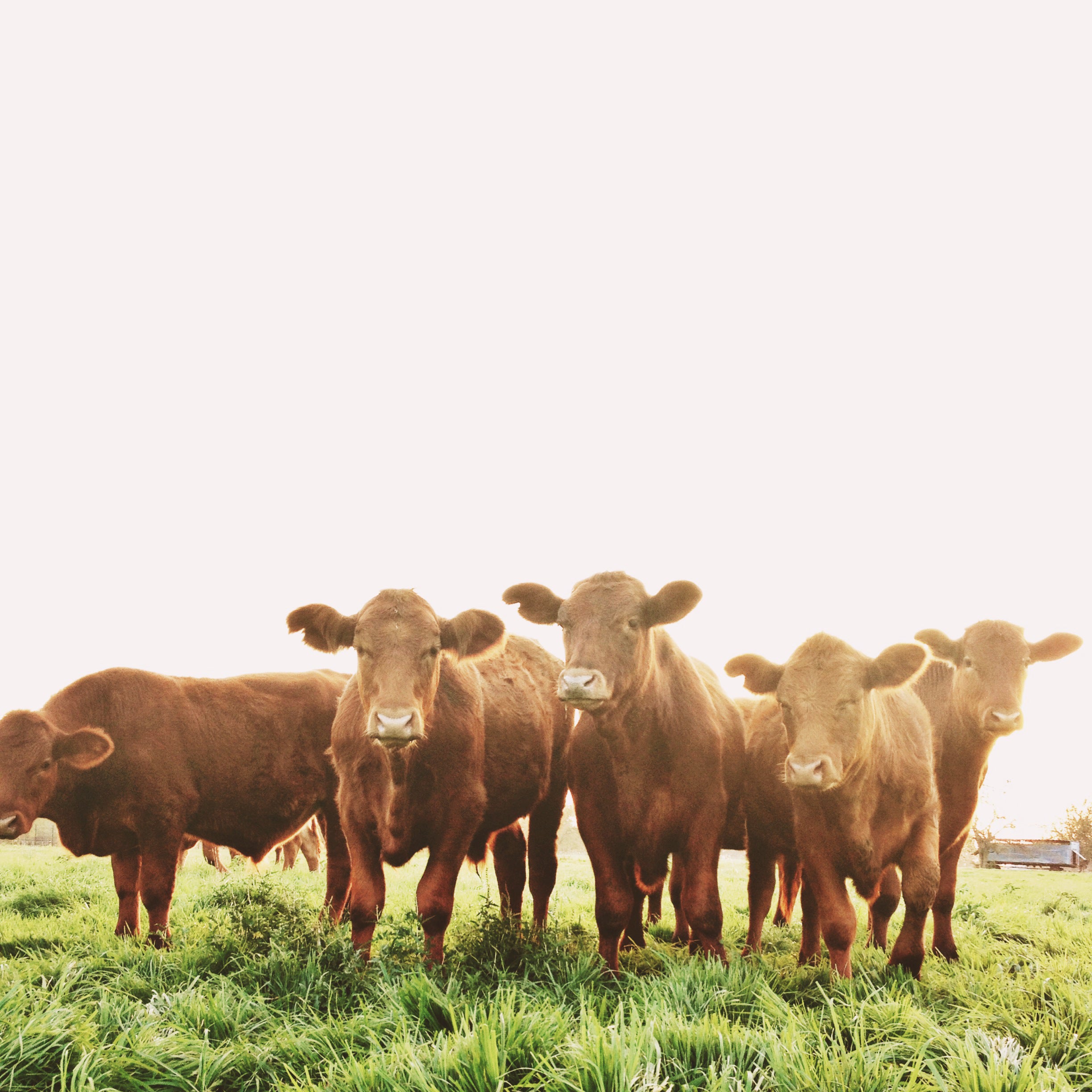
(photo of cows taken on our farm, Spring 2009)

We get a lot of questions about how to cook grass-fed meats- especially beef.

The truth is that cooking grass-fed beef is entirely different. When we first began cooking our meats from the first wave of meats that came back from the processor, I was a little disappointed in the tenderness in the beef. Okay....really disappointed.

But, I was treating our wonderfully raised grass-fed grass-finished beef as I would corn-fed feedlot beef.

Once I figured out the cooking technique, I fell in love with our beef (and pork and chicken for that matter). The flavors are rich, the broths are thick, and the texture is just as it should be.

I found this article on Kelly the Kitchen Kop (wonderful site full of great info) to be extremely helpful with a lot of good information and tips on how to cook grass-fed beef.

5 Ways to Achieve Grass-fed Beef Cooking Nirvana 

Click on the link above to go to an amazing article chock full of cooking techniques. And then, be sure to subscribe to Kelly's blog. You'll be thrilled you did!